U.S. flag

An official website of the United States government

Here’s how you know

Dot gov

Official websites use .gov
A .gov website belongs to an official government organization in the United States.

HTTPS

Secure .gov websites use HTTPS
A lock (LockA locked padlock) or https:// means you’ve safely connected to the .gov website. Share sensitive information only on official, secure websites.

 
NIH National Institute of Dental and Craniofacial Research (NIDCR) Home page
  • Health Info
  • Research
  • Grants & Funding
  • Careers & Training
  • News & Events
  • About Us
  • Health Info
    • Publications
    • Clinical Trials
    • Data & Statistics
    • Finding Dental Care
  • Research
    • Research Conducted at NIDCR (Intramural)
    • Conducting NIDCR Clinical Research
    • Clinical Trials
    • Data & Statistics
    • Scientific Data Sharing
    • Research Priorities
    • Research Investments & Advances
    • Oral Health in America Report
    • COVID-19
  • Grants & Funding
    • Notices of Funding Opportunities
    • Grant Programs and Contacts
    • Funding Priorities
    • Funded Research
    • Scientific Data Sharing
  • Careers & Training
    • Research Training at NIDCR (Intramural Opportunities)
    • Funding for Research Training (Extramural Opportunities)
    • Job Openings
    • Loan Repayment
    • Staff Contacts
  • News & Events
    • NIDCR News
    • Newsletter
    • Grantee News
    • Events
    • Images
    • For Reporters
  • About Us
    • Leadership & Staff
    • Advisory Committees
    • Strategic Plan
    • Oral Health in America Report
    • Congressional & Budget
    • Job Openings
    • Getting to NIDCR
    • Contact Us
    • Mission
  • Conducting NIDCR Clinical Research

Breadcrumb

  1. Home
  2. Health Info
  3. Publications

Return to Catalog

Questions?

Contact the National Oral Health Information Center

1-866-232-4528

nidcrinfo@mail.nih.gov

Al tratar los trastornos temporomandibulares, con frecuencia hacer menos es lo mejor
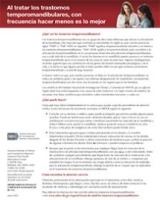
Spanish cover of “Al tratar los trastornos temporomandibulares, con frecuencia hacer menos es lo mejor” fact sheet.

The Spanish version of “Less is Often Best in Treating TMD.” This fact sheet gives an overview of temporomandibular disorders, offers self-care practices that may help, and cautions about treatments that might not be necessary.

Download PDF in English: 1 page
Download PDF in Spanish: 1 page
Descargar PDF en inglés :
1
página
English Version

Related Publications

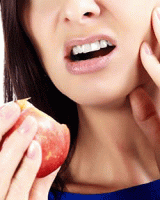
A Spanish woman holding her jaw after biting into an apple to depict a TMD (Temporomandibular Disorder).
Temporomandibular Disorders
Los trastornos temporomandibulares
A woman holding her jaw after biting into an apple to depict a TMD (Temporomandibular Disorder).
Temporomandibular Disorders
TMD (Temporomandibular Disorders)
NIH
  • Home
  • Web Policies
  • Privacy
  • Contact Us
  • Freedom of Information Act
  • No Fear Act
  • Office of Inspector General
  • HHS Vulnerability Disclosure
  • Employee Intranet - Staff Only
Back to top