



Fever Blisters & Canker Sores
Overview
Both fever blisters and canker sores are common lesions and can be painful. However, they are separate conditions with different causes. Read further to learn how to tell them apart and find out which treatments might help ease the pain.
Fever blisters (also known as cold sores or herpes labialis) are painful fluid-filled sores that form on the outside of the mouth around the lips. Fever blisters are very contagious.
Canker sores (also called aphthous ulcers) are painful white or yellow sores that only form inside the mouth, usually on the insides of the cheeks or lips or on the tongue. Canker sores are not contagious.
Back to topCauses
Fever blisters are caused by an infection with the herpes simplex virus, usually the type 1 form, called HSV-1. Around 60 percent of U.S. adults have the virus1,2 although many people with the infection never show symptoms. Once infected, the virus generally stays in the nerve cells. It can become active from time to time, traveling to the skin and causing fever blisters.
Canker sores do not have a known cause. They are most common during puberty, when certain growth-related hormones are higher.3 Canker sores may be triggered by the following factors,4 though reports vary:
- An injury (such as an accidental cheek or lip bite)
- Hormonal imbalances
- Systemic diseases (such as inflammatory bowel disease or celiac disease)
- Emotional stress
- Smoking cessation
- Nutritional deficiencies in folic acid, iron, or vitamin B12
Symptoms
Symptoms of fever blisters:
- Some people may never develop symptoms
- Others may have mild symptoms, such as:
- Fluid-filled blisters on the outside of the mouth around the lips
- Burning or tingling sensation before the blisters appear
- More severe symptoms include fever, fatigue, or swelling of the lymph nodes, similar to other viral infections
Symptoms of canker sores:
- A round white or yellow sore with a red border inside the mouth, usually on the inside of the lips or cheeks, on the gums, or on the tongue
- Pain or soreness, especially when eating, drinking, or talking
- A burning or tingling sensation in the area before the sore appears
Diagnosis
A doctor can usually diagnose canker sores and fever blisters by looking at them.
The main way to tell the difference between a fever blister and a canker sore is by location. Fever blisters occur outside the mouth, generally around the border of the lips. Canker sores occur inside the mouth.
They also differ in appearance. Fever blisters are patches of several small fluid-filled blisters, while canker sores are usually single round white or yellow sores with a red border. Tests are rarely needed but may be done if sores are severe, don’t heal, or keep coming back. Sometimes, a small sample may be taken and tested in a laboratory.
| Fever Blisters vs. Canker Sores | Fever Blisters | Canker Sores |
|---|---|---|
| Overview: | Fever blisters (also known as cold sores or herpes labialis) are painful fluid-filled sores that form on the outside of the mouth around the lips. | Canker sores (also called aphthous ulcers) are painful white or yellow sores that only form inside the mouth, usually on the insides of the cheeks or lips or on the tongue. |
| Location: | On the outside of the mouth around the lips | Inside the mouth |
| Symptoms and Appearance: | Collection of small, fluid-filled blisters Burning or tingling sensation at the site where the blisters will appear 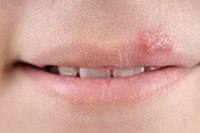
| Usually a single round white or yellow painful sore with a red border A burning or tingling sensation may occur in the mouth prior to the formation of the sore 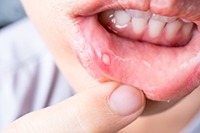
|
| Cause: | An infection with the herpes simplex virus type 1, or HSV-1 | Unknown; possible triggers include injury (e.g., accidental cheek or lip bite), emotional stress, smoking cessation, or deficiencies in certain vitamins and minerals |
| Contagious? | Yes | No |
Treatment
Typically, both types of sores go away on their own in 1–2 weeks, and treatment is not usually required. There is no known treatment that can permanently cure fever blisters or canker sores and prevent them from recurring. Treatment helps relieve the pain and speed up healing.
Fever blisters can be treated with antiviral medicines (creams or pills) prescribed by a doctor if needed. See a doctor if your cold sores last longer than a few weeks, you have a high fever, or you notice eye irritation.
Canker sores can be treated with over-the-counter (non-prescription) gels to numb the pain. Rinsing the mouth with over-the-counter antiseptic medications may help prevent infection of the sore and speed up healing.
See a doctor if you have frequently recurring canker sores or if the sores are severe enough to make eating or drinking difficult.
Back to topHelpful Tips
Both fever blisters and canker sores can have triggers that produce flare ups. Try to identify and then avoid triggers so your flare ups become less frequent.
Tips for Fever Blisters
- Sun exposure may sometimes trigger outbreaks of fever blisters. If you have recurring blisters, using sunscreen may help reduce their frequency.
- Fever blisters are contagious. Avoid kissing, sharing eating utensils, cups, water bottles, or other items if you are experiencing symptoms.
- Avoid touching the blister and then your eyes to prevent the infection from spreading to your eyes, which can cause blindness.
- Be aware that in young children, fever blisters can cause loss of appetite, drooling, and fever that can last for several days.
- Talk to your doctor or your child’s pediatrician if symptoms are severe or recur frequently.
Tips for Canker Sores
- Canker sores occur less frequently after puberty.
- If you regularly get canker sores, talk to your doctor about testing for certain diseases (e.g., celiac disease) or nutritional deficiencies.
- Avoid hot, acidic, or spicy foods, which can not only cause pain in existing ulcers but may also trigger new ulcers.
- Do not use mouthwashes that contain alcohol because they could irritate the sores.
Additional Resources
- MedlinePlus (Fever Blisters)
Information about oral herpes (the infection that causes cold sores) from the NIH National Library of Medicine. - MedlinePlus (Canker Sores)
Information about canker sores from the NIH National Library of Medicine.
References
- Ageeb RA, Harfouche M, Chemaitelly H, Abu-Raddad LJ. Epidemiology of herpes simplex virus type 1 in the United States: Systematic review, meta-analyses, and meta-regressions. iScience. 2024 Aug 5;27(9):110652. doi: 10.1016/j.isci.2024.110652.
- McQuillan G, Kruszon-Moran D, Flagg EW, Paulose-Ram R. Prevalence of herpes simplex virus type 1 and type 2 in persons aged 14–49: United States, 2015–2016. NCHS Data Brief. 2018 Feb;(304):1-8.
- Baccaglini L, Shuster JJ, Theriaque DW, Naveed Z. Elevated serum insulin-like growth factor 1 in recurrent aphthous stomatitis. Clin Exp Dent Res. 2019 Mar 27;5(3):269-275. doi: 10.1002/cre2.181.
- Slebioda Z, Szponar E, Kowalska A. Etiopathogenesis of recurrent aphthous stomatitis and the role of immunologic aspects: Literature review. Arch Immunol Ther Exp (Warsz). 2014 Jun;62(3):205-15. doi: 10.1007/s00005-013-0261-y. Epub 2013 Nov 12.
August 2026