



TMD (Temporomandibular Disorders)
Overview
Temporomandibular disorders (TMDs) are a group of more than 30 conditions that cause pain and dysfunction in the jaw joint and muscles that control jaw movement. “TMDs” refers to the disorders, and “TMJ” refers to the temporomandibular or jaw joint itself. People have two TMJs; one on each side of the jaw. You can feel them by placing your fingers in front of your ears and opening your mouth.
There are three broad categories of TMDs and several disorders within each category:
- Disorders of the joints, including disc disorders
- Disorders of the muscles used for chewing (masticatory muscles)
- Headaches associated with a TMD
See diagram below for some examples.
Classification of Temporomandibular Disorders (TMDs) with Examples1,2,3
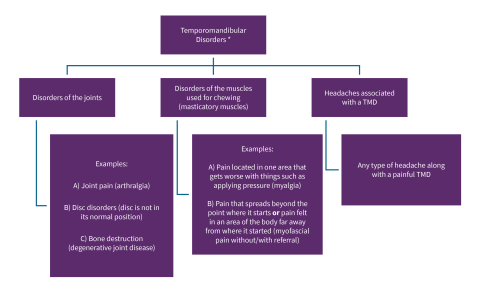
*A person may have one or more of these conditions at the same time.
Many TMDs last only a short time and go away on their own. However, in some cases they can become chronic, or long-lasting. TMDs may also occur on their own or together with other conditions such as headaches, back pain, sleep problems, irritable bowel syndrome, and fibromyalgia (a condition that causes widespread pain and fatigue). TMD affects about 5% of adults in the U.S., but this number can vary depending on who is studied and how the condition is assessed.
TMDs are twice as common in women than in men, especially in women between 35 and 44 years old.
Back to topCauses
Injury to the temporomandibular joint can lead to some TMDs, but in most cases, the exact cause is not clear. For many people, symptoms seem to start without obvious reason. Research suggests that a combination of genes, psychological and life stressors, and how someone perceives pain, may play a part in why TMD develops and whether it becomes long-lasting.4,5,6,7
Because TMDs are more common in women than in men, researchers are exploring whether the differences in TMJ structure and function between females and males may play a role.
Research does not support the belief that a bad bite or orthodontic treatment (such as braces) causes TMDs.8,9,10
Back to topSymptoms
It is important to know that clicking or popping sounds in the TMJs, without pain, are common, are considered normal, and do not require treatment.
However, the following symptoms may signal a TMD:
- Pain in the chewing muscles and/or jaw joint (most common symptom)
- Pain that spreads to the face or neck
- Jaw stiffness
- Limited movement or locking of the jaw
- Painful clicking, popping, or grating in the jaw joint when opening or closing the mouth
- Ringing in the ears, hearing loss, or dizziness
- A change in the way the upper and lower teeth fit together
Diagnosis
There is no widely accepted, standard test available to diagnose TMDs. Because TMDs can have different causes and symptoms that overlap with other conditions, diagnosis can be difficult.
Your doctor or dentist will note your symptoms and take a detailed medical history. They will ask questions about your pain, where and when it occurs, what makes it better or worse, and whether it spreads to other parts of your jaw, face, or body. The doctor or dentist may also ask about other pain conditions such as headaches or back pain.
They may examine your head, neck, face, and jaw for tenderness; jaw clicking or popping; or difficulty with movement. They may also recommend imaging tests such as an x-ray, magnetic resonance imaging (MRI), or a computed tomography (CT) scan.
Pain in the mouth, jaw, or face may or may not be related to TMDs. Your doctor or dentist may have to rule out other conditions before diagnosing a TMD.
Back to topTreatment
Before receiving treatment for TMDs, you should know:
- Sounds without pain in the TMJs are normal, happen frequently, and do not need treatment.
- Signs and symptoms of TMD go away without treatment for many people.
- Because evidence for many TMD treatments is limited, experts recommend conservative treatments and avoiding treatments that permanently change the jaw joints, teeth, or bite, or involve surgery.
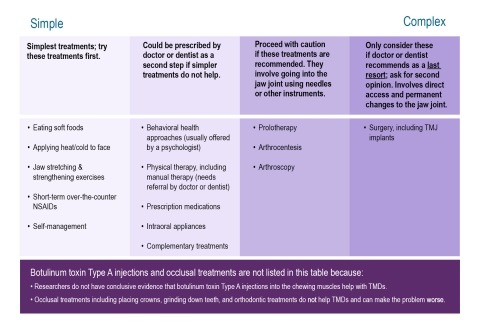
Nonsurgical Treatments
Many jaw joint and muscle problems are temporary and do not get worse, therefore, simple treatment may be all that is necessary.
When you first feel discomfort in your jaw joints or muscles, your doctor or dentist may have you:
- Eat soft foods.
- Apply heat or cold to the face in combination with exercises to gently stretch and strengthen the jaw muscles.
- Take over-the-counter pain medications, for example nonsteroidal anti-inflammatory drugs (NSAIDs), like ibuprofen.
- Reduce habits such as jaw clenching, gum chewing, or nail biting.
If these steps do not help, or if your doctor or dentist identifies a specific type of TMD, one or more of the following treatments may be recommended.
Physical Therapy
The goal of physical therapy is to maintain, improve, or bring back movement and physical function. Research suggests that manual therapy, a type of physical therapy in which a therapist uses their hands to stretch the soft tissues and muscles around the joint, can help improve function and relieve pain.11
Self-Management and Behavioral Health Approaches
Self-management refers to activities you can do yourself and includes:
- Learn all you can about your specific type(s) of TMD.
- Become aware of and reduce habits such as jaw clenching, gum chewing, or nail biting.
- Practice meditation and relaxation techniques.
- Set specific goals related to managing your condition.
- Stay involved in activities that are meaningful to you.
Certain behavioral health approaches, such as cognitive behavioral therapy and biofeedback therapy, usually offered by a psychologist, can help manage TMDs.12
Cognitive behavioral therapy seeks to identify negative thoughts or thought patterns and change them, as well as provide coping skills.
Biofeedback therapy involves the use of sensors that monitor breathing, heart rate, muscle contraction, and temperature. For example, a sensor on your jaw can detect when you tighten your jaw muscles. With the help of a therapist, you can learn to notice unwanted behavior and control your response (e.g., relax your jaw muscles).
Medications
Your doctor or dentist may recommend medicine(s) to treat your symptoms.
These include:
- Over-the-counter medicines such as:
- Nonsteroidal anti-inflammatory drugs (NSAIDs), used to treat pain
- Prescription medicines such as:
- Antianxiety medicines
- Antidepressants
- Antiseizure medicines
- Opioids
There is limited evidence available to help decide which medicines are most effective in reducing TMD pain.13 Some of these medicines can lead to addiction or have other serious side effects. If you are prescribed any medicines, make sure your doctor or dentist explains how to take them and for how long.
Intraoral Appliances
Intraoral appliances are devices that fit over the teeth and protect the teeth and may help with habit reversal, such as jaw clenching. They do not change the teeth or bite. They are also known as nightguards, splints, stabilization appliances, occlusal splints, interocclusal splints, or bruxism splints.
There is not a lot of evidence on whether they improve TMD pain.14,15,16 If a dentist or doctor suggests you use one:
- Make sure it is not designed to permanently change your bite.
- Stop using it and consult your dentist or doctor if it causes pain.
Complementary Treatments
A complementary treatment is a non-mainstream practice used together with conventional medicine. Acupuncture and transcutaneous electrical nerve stimulation (TENS) are two complementary treatments that have been studied for TMDs.
Acupuncture is a technique in which practitioners stimulate specific points on the body—most often by inserting thin needles through the skin. There is limited evidence that it helps TMDs.17,18
TENS is a battery-powered device that uses electrodes placed on the skin. The device creates electrical impulses that may change how pain is perceived. Although some studies have shown that TENS may help relieve pain in TMDs and improve the ability to open the mouth, the studies were small with only short-duration TENS treatments.19,20,21
Surgery and Other Medical & Dental Procedures
The treatments discussed in this section are more complex, involve going into the chewing muscles or the TMJs (with a needle or other instrument), or changing your bite and teeth. More importantly, some of them—like occlusal treatments (see below)— don’t work and may make the problem worse. Before having any of these procedures:
- Ask about simpler treatments and try those first.
- Ask the doctor or dentist to explain how the procedure may help your specific TMD and what risks are involved—in detail—in a way you can understand.
- Get second opinions from qualified medical or dental specialists.
Occlusal Treatments
Occlusion refers to how teeth fit together. For years it was thought that misaligned teeth (malocclusion) were a cause of TMDs; however, current evidence does not support a strong link between malocclusion and TMDs.8,9,10 Occlusal treatments modify the teeth and bite. Examples include:
- Placing crowns on the teeth
- Grinding down the teeth
- Using orthodontic treatment(s) to change the position of some or all teeth
There is insufficient evidence that these occlusal treatments work to treat TMDs, and in some cases they make the problem worse.
Botulinum Toxin
Botulinum toxin Type A works by relaxing muscles. It is approved by the U.S. Food and Drug Administration (FDA) for some medical conditions (like migraines) but not for TMDs. Studies have evaluated botulinum toxin Type A for TMDs, but results have been mixed. It remains unclear whether this treatment is effective for relieving TMD symptoms.
Prolotherapy
Prolotherapy involves injecting a solution into the TMJ area that causes irritation, with the goal of triggering the body to respond by repairing the joint. Prolotherapy has shown promise specifically for TMDs in which the joint is out of its normal position (dislocation) or when the joint goes beyond its normal range of movement (hypermobility). However, there have been only a few small studies on this treatment for TMDs.22
Arthrocentesis
In this procedure, a needle is used to push liquid into the TMJ. The pressure caused by the liquid removes scar-like tissue (adhesions). In addition, when the liquid is flushed out of the joint, it removes substances that cause inflammation. Arthrocentesis has been shown to help with pain relief and improve mouth opening in people whose temporomandibular disc is out of place; however, studies have shown inconsistent results, and treatment outcomes vary by patient.23
Arthroscopy
During arthroscopy, the doctor inserts an instrument with a tiny video camera into the jaw joint. The doctor can see the joint, which can help in diagnosis. He or she can also remove adhesions or reposition the joint’s disc. This procedure works moderately well in helping to improve pain and function.
Surgery
Open surgery gives access to the TMJ through a cut (incision) next to the ear. It’s important to know that surgery makes permanent changes to your joint. There are no long-term research studies on the safety of open surgery for TMDs or on how well it works to relieve symptoms.
Surgery should only be considered if:
- There is destruction of the joint that cannot be fixed with other procedures.
- There are severe symptoms (pain and/or difficulty opening the mouth), despite trying other treatments.
If your health care provider suggests surgery, be sure to ask:
- Why are you suggesting surgery?
- Are there other options besides surgery?
- How will it help me?
- What are the risks?
TMJ Implants
Implants are artificial devices that are used to replace part of the jaw joint or the entire joint. There are currently two TMJ implants approved by the FDA.
Implants might be considered when:
- There is an injury to the joint.
- There is a condition you’re born with (a congenital condition) that needs to be repaired.
- The joint is frozen (ankylosis), commonly caused by injury or infection.
- There is severe damage to the joint.
- There is ongoing pain.
- All simpler treatments have been tried and have failed.
Some studies suggest that, when used in very specific cases, TMJ implants can improve function and quality of life.
Some TMJ implants used in the past were associated with serious complications and were therefore removed from the market. Current FDA-approved implants are different, but researchers continue to study their long-term safety and effectiveness.
As with any surgery, it is important to discuss the potential benefits and risks with your surgeon before deciding whether this treatment is right for you. If possible, seek an opinion from a surgeon who specializes in treating TMDs.
Summary of Treatments for Temporomandibular Disorders (TMDs)24
Helpful Tips
If you think you have a TMD or are diagnosed with one:
- Consult a dentist or doctor.
- Learn all you can about the TMD you have.
- Start with simple treatments first; remember that TMD symptoms often go away on their own, without treatment.
- Before considering irreversible treatments, such as surgery, TMJ implants, or treatments that permanently change the teeth, bite, or jaw joints, discuss the potential benefits, risks, and alternatives with your doctor or dentist. Consider seeking a second opinion from an orofacial pain specialist, if possible.
Additional Resources
- Temporomandibular Disorders and Jaw Pain
- MedlinePlus: Temporomandibular Disorders
The NIH National Library of Medicine's collection of links to government, professional, and nonprofit/voluntary organizations with information on temporomandibular disorders. - The TMJ Association
The TMJ Association is a nonprofit, patient advocacy organization whose mission is to improve the quality of health care and the lives of everyone affected by temporomandibular disorders. - The American Chronic Pain Association (ACPA)
The ACPA offers peer support and education in pain management skills to people with pain, their families and friends, and health care professionals.
TMD Clinical Trials from NIDCR
Learn more about TMD clinical trials from NIDCR.
Back to topReferences
- National Academies of Sciences, Engineering, and Medicine; Health and Medicine Division; Board on Health Care Services; Board on Health Sciences Policy; Committee on Temporomandibular Disorders (TMDs): From Research Discoveries to Clinical Treatment. Temporomandibular Disorders: Priorities for Research and Care. Yost O, Liverman CT, English R, Mackey S, Bond EC, editors. Washington (DC): National Academies Press (US); 2020 Mar 12. doi: 10.17226/25652.
- Peck CC, Goulet JP, Lobbezoo F, Schiffman EL, Alstergren P, Anderson GC, et al. Expanding the taxonomy of the diagnostic criteria for temporomandibular disorders. J Oral Rehabil. 2014 Jan;41(1):2-23. doi: 10.1111/joor.12132.
- Schiffman E, Ohrbach R. Executive summary of the Diagnostic Criteria for Temporomandibular Disorders for clinical and research applications. J Am Dent Assoc. 2016 Jun;147(6):438-45. doi: 10.1016/j.adaj.2016.01.007. Epub 2016 Feb 26.
- Slade GD, Ohrbach R, Greenspan JD, Fillingim RB, Bair E, Sanders AE, et al. Painful temporomandibular disorder: Decade of discovery from OPPERA studies. J Dent Res. 2016 Sep;95(10):1084-92. doi: 10.1177/0022034516653743. Epub 2016 Jun 23.
- Da-Cas CD, Valesan LF, Nascimento LPD, Denardin ACS, Januzzi E, Fernandes G, et al. Risk factors for temporomandibular disorders: A systematic review of cohort studies. Oral Surg Oral Med Oral Pathol Oral Radiol. 2024 Oct;138(4):502-515. doi: 10.1016/j.oooo.2024.06.007. Epub 2024 Jun 19.
- Yan Q, Liao L, He D. Risk factors associated with temporomandibular joint disorder: A mendelian randomization analysis. J Oral Rehabil. 2024 Nov;51(11):2239-2247. doi: 10.1111/joor.13795. Epub 2024 Jul 23.
- Melis M, Di Giosia M. The role of genetic factors in the etiology of temporomandibular disorders: A review. Cranio. 2016 Jan;34(1):43-51. doi: 10.1179/2151090314Y.0000000027. Epub 2014 Sep 14.
- Manfredini D, Lombardo L, Siciliani G. Temporomandibular disorders and dental occlusion. A systematic review of association studies: End of an era? J Oral Rehabil. 2017 Nov;44(11):908-923. doi: 10.1111/joor.12531. Epub 2017 Jul 2.
- Kalladka M, Young A, Thomas D, Heir GM, Quek SYP, Khan J. The relation of temporomandibular disorders and dental occlusion: a narrative review. Quintessence Int. 2022 Apr 5;53(5):450-459. doi: 10.3290/j.qi.b2793201.
- Thomas DC, Singer SR, Markman S. Temporomandibular disorders and dental occlusion: What do we know so far? Dent Clin North Am. 2023 Apr;67(2):299-308. doi: 10.1016/j.cden.2022.11.002. Epub 2023 Feb 1.
- Armijo-Olivo S, Pitance L, Singh V, Neto F, Thie N, Michelotti A. Effectiveness of manual therapy and therapeutic exercise for temporomandibular disorders: Systematic review and meta-analysis. Phys Ther. 2016 Jan;96(1):9-25. doi: 10.2522/ptj.20140548. Epub 2015 Aug 20
- Penlington C, Bowes C, Taylor G, Otemade AA, Waterhouse P, Durham J, et al. Psychological therapies for temporomandibular disorders (TMDs). Cochrane Database Syst Rev. 2022 Aug 11;8(8):CD013515. doi: 10.1002/14651858.CD013515.pub2.
- Mujakperuo HR, Watson M, Morrison R, Macfarlane TV. Pharmacological interventions for pain in patients with temporomandibular disorders. Cochrane Database Syst Rev. 2010 Oct 6;(10):CD004715. doi: 10.1002/14651858.CD004715.pub2.
- Singh BP, Singh N, Jayaraman S, Kirubakaran R, Joseph S, Muthu MS, et al. Occlusal interventions for managing temporomandibular disorders. Cochrane Database Syst Rev. 2024 Sept 16(9):CD012850. doi: 10.1002/14651858.CD012850.pub2.
- Zhang C, Wu J, Deng D, He B, Tao Y, Niu Y, et al. Efficacy of splint therapy for the management of temporomandibular disorders: a meta-analysis. Oncotarget. 2016 Dec 20;7(51):84043-84053. doi: 10.18632/oncotarget.13059.
- Fricton J. Current evidence providing clarity in management of temporomandibular disorders: Summary of a systematic review of randomized clinical trials for intra-oral appliances and occlusal therapies. J Evid Based Dent Pract. 2006 Mar;6(1):48-52. doi: 10.1016/j.jebdp.2005.12.020.
- Peixoto KO, Abrantes PS, De Carvalho IHG, De Almeida EO, Barbosa GAS. Temporomandibular disorders and the use of traditional and laser acupuncture: A systematic review. Cranio. 2023 Nov;41(6):501-507. doi: 10.1080/08869634.2021.1873605. Epub 2021 Jan 12. PMID: 33433268.
- Di Francesco F, Minervini G, Siurkel Y, Cicciù M, Lanza A. Efficacy of acupuncture and laser acupuncture in temporomandibular disorders: A systematic review and meta-analysis of randomized controlled trials. BMC Oral Health. 2024 Feb 3;24(1):174. doi: 10.1186/s12903-023-03806-1.
- Fertout A, Manière-Ezvan A, Lupi L, Ehrmann E. Management of temporomandibular disorders with transcutaneous electrical nerve stimulation: A systematic review. Cranio. 2022 May;40(3):217-228. doi: 10.1080/08869634.2019.1687986. Epub 2019 Nov 9.
- Serrano-Muñoz D, Beltran-Alacreu H, Martín-Caro Álvarez D, Fernández-Pérez JJ, Aceituno-Gómez J, Arroyo-Fernández R, et al. Effectiveness of different electrical stimulation modalities for pain and masticatory function in temporomandibular disorders: A systematic review and meta-analysis. J Pain. 2023 Jun;24(6):946-956. doi: 10.1016/j.jpain.2023.01.016. Epub 2023 Feb 18.
- Díaz L, Restelli L, Valencia E, Atalay DI, Abarca JM, Gil AC, et al. Effectiveness of low-level laser therapy on temporomandibular disorders. A systematic review of randomized clinical trials. Photodiagnosis Photodyn Ther. 2025 Jun;53:104558. doi: 10.1016/j.pdpdt.2025.104558. Epub 2025 Mar 15.
- Saramantos A, Kyrgidis A, Venetis G, Hatziantoniou G, Chrysostomidis A, Sardeli C, et al. Clinical efficacy of prolotherapy for temporomandibular joint disorders: A systematic review and meta-analysis. Clin Pract. 2025 Feb 27;15(3):51. doi: 10.3390/clinpract15030051.
- Guarda-Nardini L, De Almeida AM, Manfredini D. Arthrocentesis of the temporomandibular joint: Systematic review and clinical implications of research findings. J Oral Facial Pain Headache. 2021 Winter;35(1):17-29. doi: 10.11607/ofph.2606.
- Tran C, Ghahreman K, Huppa C, Gallagher JE. Management of temporomandibular disorders: A rapid review of systematic reviews and guidelines. Int J Oral Maxillofac Surg. 2022 Sep;51(9):1211-1225. doi: 10.1016/j.ijom.2021.11.009. Epub 2022 Mar 23.
TMD (Temporomandibular Disorders) Research from NIDCR
August 2026