



Why Aging Matters for Bone Healing: New Clues from the Rib
Uncovering the immune system’s role in bone regeneration
A resected rib in a young person can grow back with surprising ease—even if a large piece is missing. This remarkable healing ability was observed by Janice S. Lee, principal investigator of the Craniofacial Anomalies and Regeneration Section and Clinical Director at the National Institute of Dental and Craniofacial Research (NIDCR), during reconstructive surgeries on young patients born with craniofacial anomalies. However, this regenerative capacity diminishes with age, as the body’s ability to repair bone declines dramatically over time.
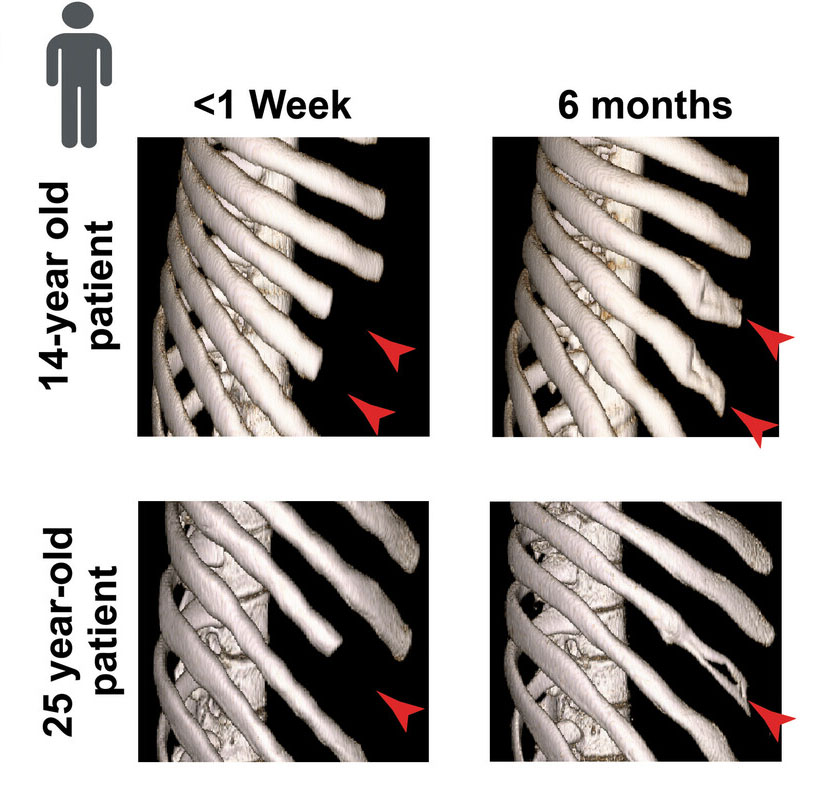
CT scans of the chests of patients aged 14 and 25 years after undergoing rib resection surgery show differences in rib regeneration (red arrowheads) between less than 1 week and 6 months post-surgery.
In a new study published in Aging Cell, scientists have uncovered some of the reasons why age and skeletal maturity limit our ability to repair large-scale bone injuries. The research, led by a team from the National Institutes of Health in collaboration with the University of Southern California (USC), points to changes in the immune system and circulating signaling factors as key players in the decline of bone regeneration with age. The research was funded by the Intramural Research Programs of NIDCR and the National Institute on Deafness and Other Communication Disorders (NIDCD).
“Rib bones are special,” said co-author Francesca Mariani, a principal investigator at USC. “Unlike most bones in the body, they have a natural ability to regenerate after a major injury—but only during certain stages of life.”
The research team mimicked this rib regeneration process in mice. They found that young, immature mice could regenerate large segments of rib bone after surgery, while mature mice could not. Instead of rebuilding bone, mature mice filled the injury site with scar-like fibrous tissue.
What is behind this loss of regenerative ability? One big clue lies in the immune system.
“In younger mice, we saw a stronger immune cell response and higher levels of pro-inflammatory molecules in the blood right after injury,” said Janice S. Lee, senior author of the study. “This may seem counterintuitive, but a well-timed immune reaction appears essential for successful regeneration.”
To test this idea further, the team used a technique called parabiosis, where two mice—one young and one old—share a common circulatory system. Remarkably, the older mouse showed improved healing when connected to a younger partner but only if the younger mouse was also healing from a bone injury. Although not all the old mice regenerated bone completely, they formed more of the essential reparative tissue than they would have alone.
“These experiments suggest that certain factors in the young mouse’s blood helped ‘rescue’ some of the regenerative potential in the older mouse,” said lead author Luciana Yamamoto de Almeida, a fellow at NIH.
The findings point to new strategies for enhancing bone repair in older adults—perhaps by boosting the activity of helpful immune cells or delivering key pro-regenerative molecules.
“With better understanding of these systemic factors, we may be able to develop therapies that restore the body’s ability to heal major bone injuries without taking bone from other sites in the body and reduce the amount of surgery that a patient must undergo,” said Lee.
Reference
de Almeida LY, Dietrich C, Hanner AS, McTighe KM, Martin D; NIDCD/NIDCR Genomics and Computational Biology Core, et al. Skeletal maturity and age-related changes in immune cells and circulatory factors impair large-scale bone regeneration. Aging Cell. 2025 Jul 21:e70177. doi:10.1111/acel.70177.
Attention Editors
Reprint this article in your own publication or post to your website. NIDCR News articles are not copyrighted. Please acknowledge NIH's National Institute of Dental and Craniofacial Research as the source.
July 2025