U.S. flag

An official website of the United States government

Here’s how you know

Dot gov

Official websites use .gov
A .gov website belongs to an official government organization in the United States.

HTTPS

Secure .gov websites use HTTPS
A lock (LockA locked padlock) or https:// means you’ve safely connected to the .gov website. Share sensitive information only on official, secure websites.

Español
Home
  • Health Info
  • Research
  • Grants & Funding
  • Careers & Training
  • News & Events
  • About Us
  • Health Info
    • Publications
    • Clinical Trials
    • Data & Statistics
    • Finding Dental Care
  • Research
    • Oral Health in America Report
    • COVID-19
    • Data & Statistics
    • Research Conducted at NIDCR (Intramural)
    • Research Funded by NIDCR (Extramural)
    • Research Priorities
    • Clinical Trials
    • Human Subjects Research
    • Scientific Data Sharing
  • Grants & Funding
    • Notices of Funding Opportunities
    • Grant Programs and Contacts
    • Funding Priorities
    • Funded Research
    • Human Subjects Research
    • Scientific Data Sharing
  • Careers & Training
    • Research Training at NIDCR (Intramural Opportunities)
    • Funding for Research Training (Extramural Opportunities)
    • NIDCR Diversity
    • Job Openings
    • Loan Repayment
    • Staff Contacts
  • News & Events
    • NIDCR News
    • Newsletter
    • Grantee News
    • Events
    • Images
    • For Reporters
  • About Us
    • Leadership & Staff
    • Advisory Committees
    • Strategic Plan
    • Oral Health in America Report
    • Congressional & Budget
    • Job Openings
    • Diversity
    • Getting to NIDCR
    • Contact Us
    • Mission

Breadcrumb

  1. Home
  2. Health Info
Health Info
  • Publications
  • Clinical Trials
  • Data & Statistics
  • Finding Dental Care

Fluoride & Dental Health

On this page

  1. Overview
  2. Helpful Tips
  3. Additional Resources
  4. Related Publications
Back to top

Overview

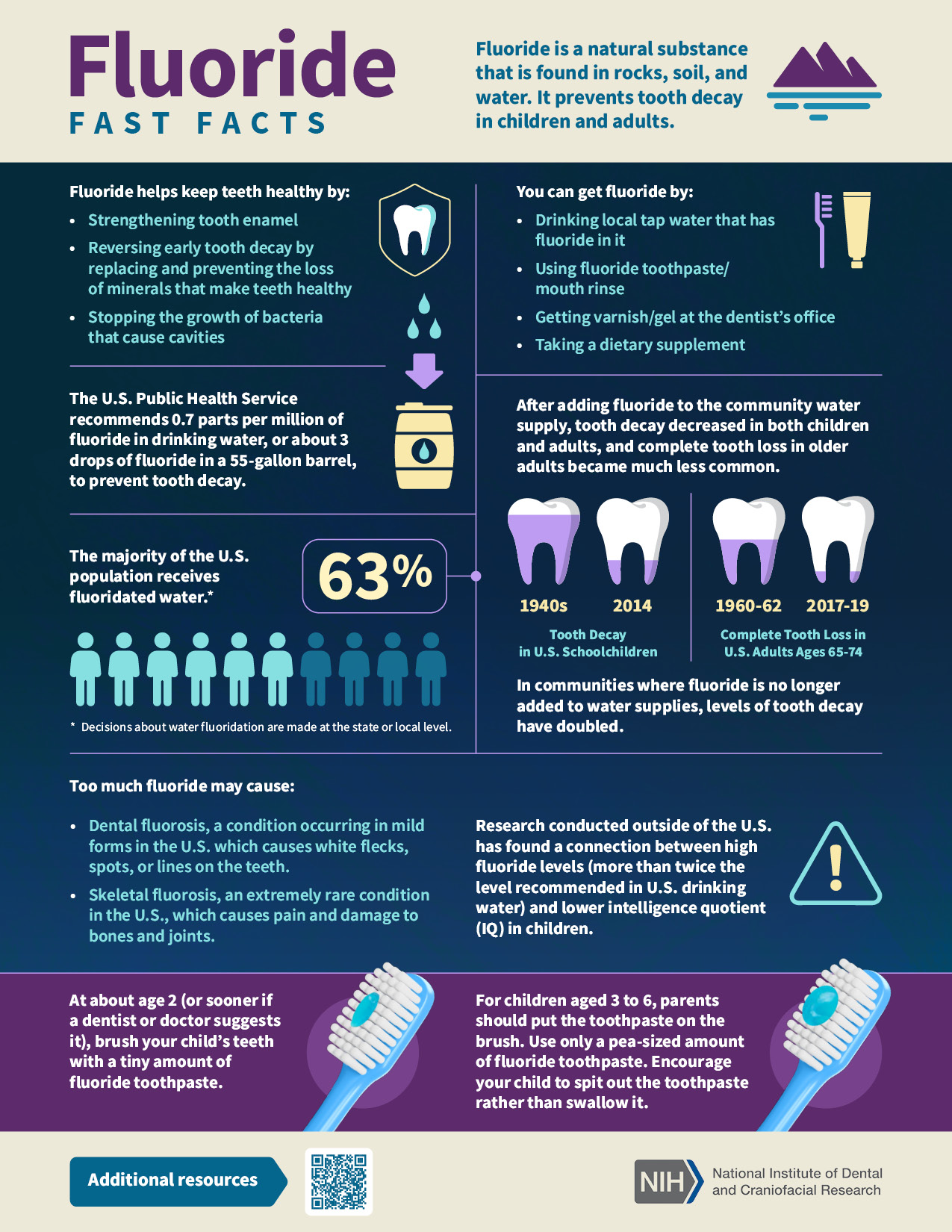
Fluoride (said like floor-eyed) is a mineral that occurs naturally in soil, water, and rocks that has been shown to prevent cavities, or tooth decay. For the past several decades, fluoride has been added to community water supplies and oral care products such as toothpaste and mouth rinse. Fluoride works by strengthening the tooth’s hard outer surface called enamel.

Read About Community Water Fluoridation.

You can get fluoride by drinking tap water in communities where the public water system adds fluoride and by using fluoride toothpaste and mouth rinse, as well as from certain foods and beverages. In the dental office, a dentist can apply fluoride varnish or gel, and in some public health programs, children can have fluoride varnish applied to their teeth.

Fluoride can prevent tooth decay across the lifespan. Fluoride hardens teeth as they form under our gums before we are born. Both children and adults benefit from it.

Ask the Expert

NIDCR Deputy Director Jennifer Webster-Cyriaque, D.D.S., Ph.D., answers common questions about fluoride and how it works to prevent tooth decay. Read the interview.

Back to top

Helpful Tips

  • The amount of fluoride in your water depends on your water source. Although some bottled waters have the recommended amount of fluoride, many do not. Fluoride levels vary depending on if you receive water from the public water system or well water. If you are interested in finding out the amount of fluoride in your community’s water, check with your local water utility company.
  • Brush with a fluoride toothpaste twice a day, floss regularly, and see a dentist for routine check-ups.
  • Ask your child’s dentist or doctor about fluoride toothpaste use. You should not use fluoride toothpaste for children younger than age 2 unless you have been advised to do so by a dentist or doctor.
Back to top

Additional Resources

  • The Tooth Decay Process: How to Reverse It and Avoid a Cavity
    Information from NIDCR about the factors contributing to dental decay and maintaining oral health. 
  • The NIH Office of Dietary Supplements has fact sheets on fluoride: one for health professionals and one for consumers (available in English and Spanish).
  • Centers for Disease Control and Prevention (CDC) Water Fluoridation page 
    An overview of community water fluoridation that provides information about benefits, safety, statistics, other fluoride products, guidelines and recommendations.
  • My Water's Fluoride (CDC) 
    My Water's Fluoride allows consumers to learn about the fluoride level in their drinking water.
  • The Story of Fluoridation 
    The story of how dental science discovered, and ultimately proved to the world, that fluoride, a mineral found in rocks and soil, prevents tooth decay.
  • MedlinePlus: Fluoride 
    The NIH National Library of Medicine's collection of links to government, professional and non-profit/voluntary organizations with information on water fluoridation.
  • Fluoridated Water
    Common cancer myths and misconceptions from the National Cancer Institute (NCI).
Back to top

Related Publications

Healthy Mouth for Your Baby
A Healthy Mouth for Your Baby

Brochure for parents on dental care for infants and toddlers.

English
PDF:
12
pages
Descargar PDF en inglés :
12
páginas
Order print version
Pedir versión impresa
Spanish
PDF:
12
pages
Descargar PDF en español :
12
páginas
Order print version
Pedir versión impresa
Back to top

Fluoride & Dental Health Research from NIDCR

  • Big Hopes for Little Teeth
Last Reviewed
November 2024
NIH
  • Home
  • NIH Staff Directory
  • Web Policies
  • Privacy
  • Contact Us
  • Freedom of Information Act
  • No Fear Act
  • Office of Inspector General
  • HHS Vulnerability Disclosure
  • Employee Intranet - Staff Only
Back to top