U.S. flag

An official website of the United States government

Here’s how you know

Dot gov

Official websites use .gov
A .gov website belongs to an official government organization in the United States.

HTTPS

Secure .gov websites use HTTPS
A lock (LockA locked padlock) or https:// means you’ve safely connected to the .gov website. Share sensitive information only on official, secure websites.

 
NIH National Institute of Dental and Craniofacial Research (NIDCR) Home page
  • Health Info
  • Research
  • Grants & Funding
  • Careers & Training
  • News & Events
  • About Us
  • Health Info
    • Publications
    • Clinical Trials
    • Data & Statistics
    • Finding Dental Care
  • Research
    • Research Conducted at NIDCR (Intramural)
    • Conducting NIDCR Clinical Research
    • Clinical Trials
    • Data & Statistics
    • Scientific Data Sharing
    • Research Priorities
    • Research Investments & Advances
    • Oral Health in America Report
    • COVID-19
  • Grants & Funding
    • Notices of Funding Opportunities
    • Grant Programs and Contacts
    • Funding Priorities
    • Funded Research
    • Scientific Data Sharing
  • Careers & Training
    • Research Training at NIDCR (Intramural Opportunities)
    • Funding for Research Training (Extramural Opportunities)
    • Job Openings
    • Loan Repayment
    • Staff Contacts
  • News & Events
    • NIDCR News
    • Newsletter
    • Grantee News
    • Events
    • Images
    • For Reporters
  • About Us
    • Leadership & Staff
    • Advisory Committees
    • Strategic Plan
    • Oral Health in America Report
    • Congressional & Budget
    • Job Openings
    • Getting to NIDCR
    • Contact Us
    • Mission
  • Conducting NIDCR Clinical Research

Breadcrumb

  1. Home
  2. News & Events
News & Events
  • NIDCR News
  • Newsletter
  • Grantee News
  • Events
  • Images
  • For Reporters
NIDCR EMAIL UPDATES 
Subscribe to receive NIDCR emails

NIDCR Digital Library

The NIDCR Digital Library provides images that are free to use with credit. Images are meant for use by the science and health community, the press that covers health and science, teachers and other educators in health and science, and non-profit organizations that produce health and science information. It is not intended for commercial use.
 

Displaying 31 - 40 of 42

Media ID#: 22961

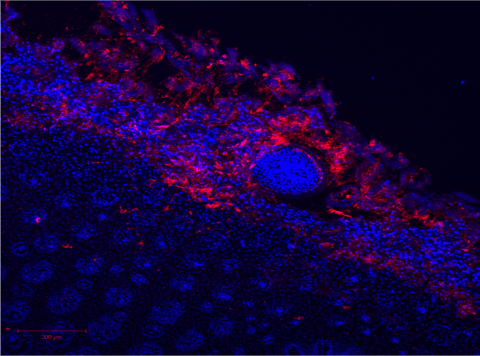
3D Permeation

Nano-particles permeating topically into the tongue tissue.
Download

Nano-particles permeating topically into the tongue tissue.
Click to view
ID#: 22961
3D Permeation

A 3D confocal image of  nano-particles permeating topically into the tongue tissue.

Asset type: Scientific Image
File size: 2.83 MB
File type: image/png

Privo Technologies

Download

Media ID#: 22966

A close look at a fruit fly salivary gland
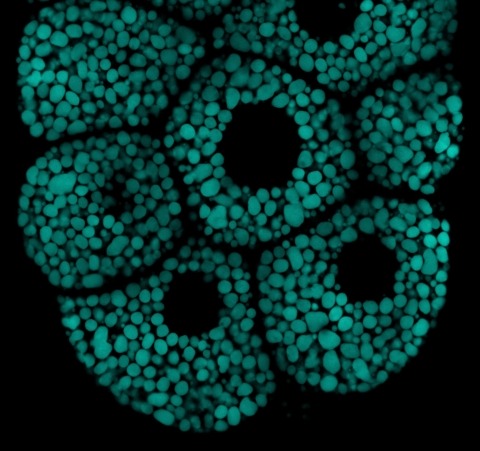
Fruit fly salivary gland shows individual cells containing secretory granules.
Download

Fruit fly salivary gland shows individual cells containing secretory granules.
Click to view
ID#: 22966
A close look at a fruit fly salivary gland

This up-close look at a fruit fly salivary gland shows individual cells containing many secretory granules (blue-green), which store proteins that aid in the fly’s lifecycle. The black region in the middle of each cell is the nucleus.

Asset type: Scientific Image
File size: 3.04 MB
File type: image/jpeg

Kelly Ten Hagen, NIDCR

Download

Media ID#: 22971

Full fruit fly salivary gland
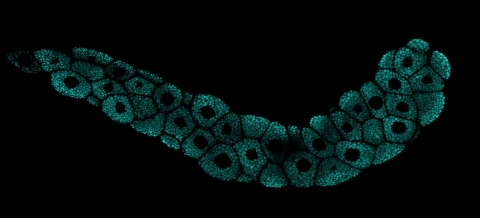
Cells in fruit fly salivary glands are filled with cellular packets known as secretory granules
Download

Cells in fruit fly salivary glands are filled with cellular packets known as secretory granules
Click to view
ID#: 22971
Full fruit fly salivary gland

Cells in fruit fly salivary glands are filled with cellular packets known as secretory granules (blue-green), which store molecules that aid in the fly lifecycle.

Asset type: Scientific Image
File size: 699.2 KB
File type: image/jpeg

Kelly Ten Hagen, NIDCR

Download

Media ID#: 22976

Fruit fly digestive system
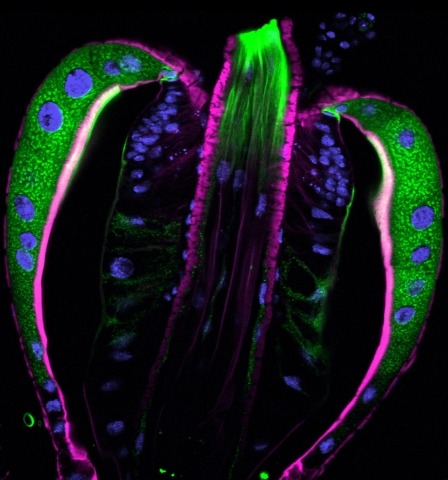
Part of a digestive organ called a proventriculus from a fruit fly larva.
Download

Part of a digestive organ called a proventriculus from a fruit fly larva.
Click to view
ID#: 22976
Fruit fly digestive system

This image shows part of a digestive organ called a proventriculus from a fruit fly larva. Cells in the organ’s outer layer are active in secreting a lining that protects the whole digestive system, similar to  the mucous lining of the human digestive system.

Asset type: Scientific Image
File size: 423.74 KB
File type: image/jpeg

Kelly Ten Hagen, NIDCR

Download

Media ID#: 22981

Creatures-crawling-within.mp4

Video file
Download

Click to view
ID#: 22981
Creatures-crawling-within.mp4

NIDCR scientists used live-cell imaging to capture fibroblasts (pink) using a “front wheel drive” method to propel themselves forward through a web of proteins (green) in a lab dish meant to mimic its 3-D environment in the human body. 

Asset type: Video, Scientific Image
File size: 744.06 KB
File type: video/mp4
Credit

Andrew Doyle and Ken Yamada, NIDCR

Download

Media ID#: 22986

Fruit fly salivary gland
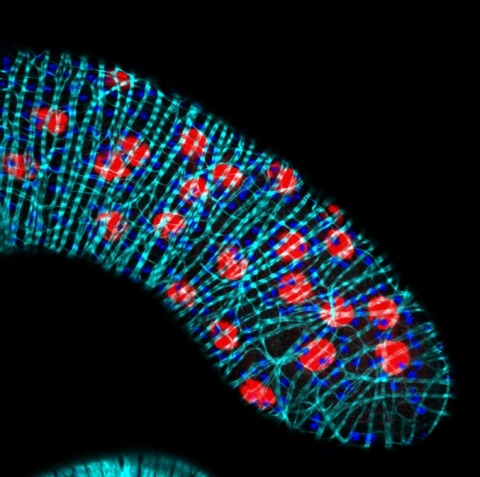
Fruit fly glands and the cellular packets.
Download

Fruit fly glands and the cellular packets.
Click to view
ID#: 22986
Fruit fly salivary gland

Understanding fruit fly glands and the cellular packets known as secretory granules (red), which store proteins destined for secretion, may help scientists better understand how secretion goes wrong, and how it might be treated, in conditions like salivary gland disorders.

Asset type: Scientific Image
File size: 136.2 KB
File type: image/jpeg

Liping Zhang, NIDCR

Download

Media ID#: 22991

Cross section of mouse embryo torso
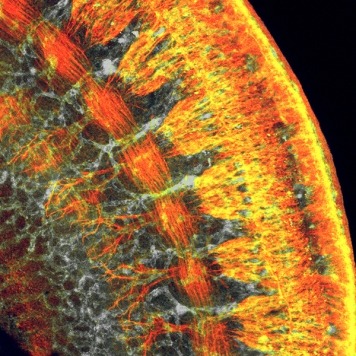
Cross section of mouse embryo torso.
Download

Cross section of mouse embryo torso.
Click to view
ID#: 22991
Cross section of mouse embryo torso

Confocal microscopy was used to create this image of a mouse embryo torso which sheds new light on mammalian development.

Asset type: Scientific Image
File size: 270.93 KB
File type: image/jpeg

Credit: Shachi Bhatt and Paul Trainor, Stowers Institute for Medical Research, Kansas City

Download

Media ID#: 23001

Salivary gland cells infected with SARS-CoV-2
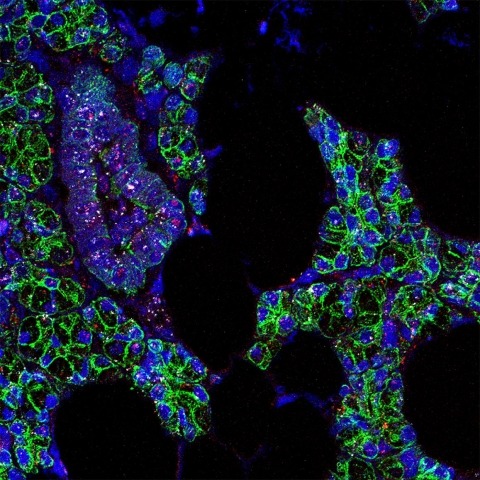
Salivary gland cells infected with SARS-CoV-2.
Download

Salivary gland cells infected with SARS-CoV-2.
Click to view
ID#: 23001
Salivary gland cells infected with SARS-CoV-2

An international team of scientists has found evidence that SARS-CoV-2, the virus that causes COVID-19, infects cells in the mouth. While it’s well known that the upper airways and lungs are primary sites of SARS-CoV-2 infection, there are clues the virus can infect cells in other parts of the body.

Asset type: Scientific Image
File size: 280.86 KB
File type: image/jpeg

Paola Perez, NIDCR

Download

Media ID#: 23006

An itch to scratch

Nerves in dorsal root ganglion.
Download

Nerves in dorsal root ganglion.
Click to view
ID#: 23006
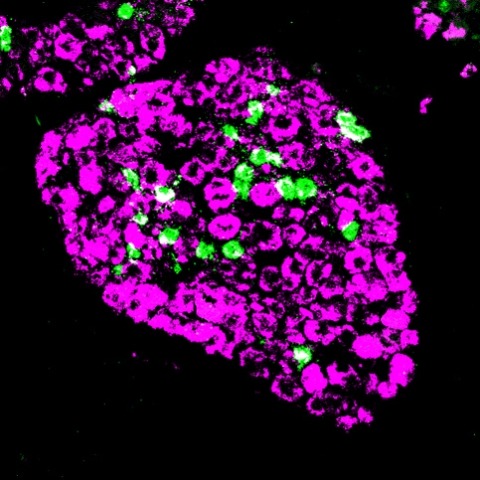
An itch to scratch

Nerves that stimulate skin are grouped in structures next to the spinal cord. Here, nerves in such a structure—called a dorsal root ganglion—that are involved in detecting an itch are labeled green. Nerves involved in sensing pain, temperature and other stimuli are shown in magenta.

Asset type: Scientific Image
File size: 293.65 KB
File type: image/jpeg

Hans Juergen Solinski, NIDCR

Download

Media ID#: 23181

Creepy crawlies on the teeth

Video file
Download

Click to view
ID#: 23181
Creepy crawlies on the teeth

This creeping creature is composed of cavity-causing bacteria (green) that piggyback on fungi (blue), forming superorganisms that “walk” and “lunge” on tooth-like surfaces. These movements allow the microbial assemblages to spread faster and farther, making them extra skilled at promoting tooth decay. 

Asset type: Video, Scientific Image
File size: 38.17 MB
File type: video/mp4
Credit

Credit: Zhi Ren, University of Pennsylvania

Download
  • Go to first pageFirst
  • Go to previous pagePrevious
  • Page 1
  • Page 2
  • Page 3
  • Currently on page 4
  • Page 5
  • Go to next pageNext
  • Go to last pageLast
NIH
  • Home
  • Web Policies
  • Privacy
  • Contact Us
  • Freedom of Information Act
  • No Fear Act
  • Office of Inspector General
  • HHS Vulnerability Disclosure
  • Employee Intranet - Staff Only
Back to top